The popularity of e-bikes and e-scooters continues to grow across Scotland, but many people remain unaware of the legal rules surrounding their use. We examine the current law, the rise in injury claims and who may be responsible when accidents happen.
For many people, e-bikes and e-scooters represent the future of transport.
They are affordable, environmentally friendly and increasingly common on our roads, cycle paths and city streets. As concerns about congestion and emissions continue to grow, so too does interest in alternative forms of transport, often referred to collectively as “micromobility”.
However, the rapid rise of e-bikes and e-scooters has also led to a growing number of accidents and injuries, raising important questions about safety, insurance and liability.
Recent reporting by the BBC highlighted concerns about the increasing number of people being injured in collisions involving e-scooters and high-powered e-bikes, while new figures released by the Motor Insurers’ Bureau (MIB) suggest the financial cost of these incidents is continuing to rise.
As the popularity of micromobility continues to grow, many people remain unclear about a simple but important question:
What Is Actually Legal, and Who Pays When Someone Gets Hurt?
Traditionally, road traffic claims have focused on motor vehicles, cyclists and pedestrians. However, the increasing presence of e-bikes and e-scooters is creating new challenges for road users, insurers and regulators alike.
Understanding the legal distinction between different types of micromobility vehicles is crucial.
What Is Micromobility?
Micromobility is a broad term used to describe small, lightweight vehicles designed for short journeys.
Examples include:
- E-scooters
- E-bikes
- Electric skateboards
- Segways
- Other powered transporters
While these forms of transport offer obvious practical benefits, they do not all fall under the same legal framework.
The distinction between e-scooters and e-bikes is particularly important, as the law treats them very differently.
Are E-Scooters Legal in Scotland?
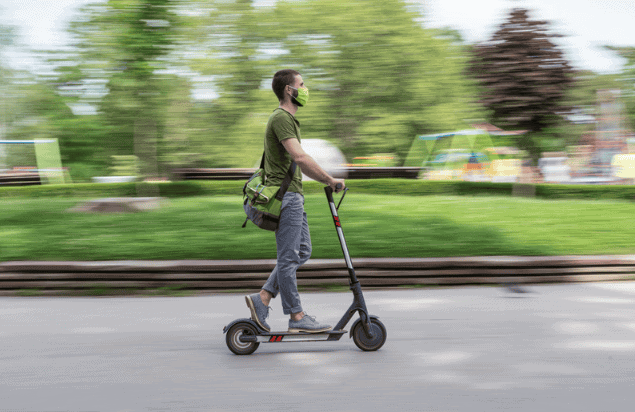
In short, privately owned e-scooters cannot currently be used legally on public roads, pavements or cycle lanes in Scotland.
Under current UK law, e-scooters are classed as motor vehicles. This means they require insurance and a valid driving licence in much the same way as a car or motorcycle. As there is currently no insurance product available for the public use of privately owned e-scooters, anyone riding one on a public road is effectively riding uninsured.
Unlike some parts of England, there are currently no government-approved rental e-scooter schemes operating in Scotland. As a result, most e-scooters seen being used on public roads or pavements in Scotland are being ridden illegally.
The penalties can be significant and may include:
- Seizure of the vehicle
- Penalty points
- Fines
- Disqualification from driving
In certain cases, riders may also face substantial financial liability if they cause injury to another person.
Are E-Bikes Legal?
The legal position for e-bikes is different.
Most road-legal e-bikes fall within the category of Electrically Assisted Pedal Cycles (EAPCs) and are not treated as motor vehicles.
To qualify as an EAPC, the bike must:
- Be fitted with pedals capable of propelling the bike
- Have a motor with a maximum continuous rated power of 250 watts
- Stop providing electrical assistance once the bike reaches 15.5mph
Where these requirements are met, the rider does not require insurance, vehicle registration or a driving licence.
However, problems arise where e-bikes are modified or supplied with motors that exceed the legal limits.
Higher-powered e-bikes and certain throttle-operated bikes may fall outside the EAPC rules and could instead be treated as motor vehicles. If that happens, the rider may require insurance, registration and a driving licence in order to use the vehicle legally.
Rising Injuries and Growing Concerns
The growing popularity of micromobility has inevitably been accompanied by an increase in accidents.
Recent media reports have highlighted serious incidents involving pedestrians, cyclists and other road users who have suffered injuries as a result of collisions involving e-scooters and e-bikes. Concerns have also been raised about the increasing availability of modified bikes capable of speeds far beyond those permitted under current regulations.
The Motor Insurers’ Bureau recently revealed that the total incurred cost of compensation claims arising from micromobility collisions has now surpassed £100 million since 2019. The organisation also reported that the number of claims increased by 73% between 2023 and 2025.
More concerning still is the severity of some of the injuries being reported.
According to the MIB, claims have included:
- Traumatic brain injuries
- Complex fractures requiring surgery
- Serious soft tissue injuries
- Long-term rehabilitation needs
For those affected, the consequences can be life-changing.
Who Pays When Someone Is Injured?
This is where the legal position becomes more complicated.
The route to compensation often depends on the type of vehicle involved and whether insurance is available.
Accidents Involving E-Scooters
Where a privately owned e-scooter is involved in a collision, the rider is likely to be uninsured.
In those circumstances, an injured person may be able to pursue a claim through the Motor Insurers’ Bureau (MIB), which compensates victims of uninsured and untraced motorists. This is the same organisation that deals with claims involving uninsured car drivers.
However, it is important to remember that compensation is not automatic.
The injured person must still establish negligence and prove that the rider’s actions caused the accident and resulting injuries.
Accidents Involving E-Bikes
Claims involving e-bikes can be more complicated.
Where the bike is a compliant EAPC, it is generally treated in the same way as an ordinary bicycle. There will often be no motor insurance policy in place and any claim may need to be pursued directly against the rider.
Where the bike has been modified or falls outside the EAPC regulations, the position may be different. In some circumstances, it may be argued that the vehicle should be treated as a motor vehicle, potentially opening the door to claims involving insurers or the MIB.
The facts of each case will be important.
Why Are We Seeing More Claims?
Part of the answer is simple: there are more e-bikes and e-scooters on the road than ever before.
However, the MIB believes there is also a significant problem with public awareness.
A recent YouGov survey cited by the MIB found that 55% of UK adults were unaware that privately owned e-scooters are illegal on public roads.
That statistic highlights the challenge facing regulators.
Many riders may not realise they are breaking the law. Others may not appreciate the legal consequences of riding an uninsured vehicle or the potential financial impact if they injure someone else.
The issue is particularly relevant for parents. E-scooters are widely available from retailers and online marketplaces and are often marketed in a way that can make them appear no different to bicycles or other recreational products. As a result, many parents purchase them for children without realising that privately owned e-scooters cannot legally be ridden on public roads, pavements or cycle lanes in Scotland.
Many people would be surprised to learn that a child riding a privately owned e-scooter to school, through a public park or along a pavement may be doing so unlawfully, despite having received the scooter as a birthday or Christmas gift.
As usage increases, so too does the likelihood of accidents, injuries and compensation claims.
Micromobility and Pedestrianised Areas
One issue that frequently generates complaints is the use of e-bikes and e-scooters in pedestrianised areas of town and city centres.
Many people will have encountered delivery riders travelling through busy pedestrian zones while carrying out deliveries for app-based services. Concerns are often raised about speed, pedestrian safety and whether these vehicles should be using such areas at all.
The legal position will depend on the location and any local restrictions in place. Some pedestrianised areas permit cycling, while others prohibit it entirely or restrict access during certain times of day.
Where cycling is permitted, riders using lawful Electrically Assisted Pedal Cycles (EAPCs) may also be permitted to access those areas.
Even where cycling is permitted, riders must take reasonable care for the safety of pedestrians. City centre environments can present particular risks due to high footfall, limited visibility and the presence of vulnerable road users, including children, older people and those with mobility difficulties.
For e-scooters, the position is generally more straightforward. As privately owned e-scooters cannot legally be used on public roads, pavements or cycle lanes in Scotland, their presence in many public pedestrian areas is likely to raise additional legal concerns.
Where collisions occur, liability will always depend on the circumstances. Factors such as speed, visibility, pedestrian density and compliance with local restrictions may all be relevant when determining fault.
As micromobility continues to grow, balancing the needs of riders with pedestrian safety is likely to remain an important challenge for local authorities and policymakers.
The Future of Micromobility
Despite the legal and safety concerns, micromobility is unlikely to disappear.
E-bikes and e-scooters offer clear environmental and practical benefits, particularly in cities where reducing congestion and emissions remains a priority.
The challenge for policymakers will be ensuring that regulation keeps pace with technology.
The MIB has recently called for greater public awareness and a clearer understanding of the law surrounding micromobility vehicles, noting that confusion remains widespread despite the rising number of injuries and compensation claims.
It is likely that we will see continued debate around:
- E-scooter legalisation
- Insurance requirements
- Vehicle safety standards
- Enforcement of existing laws
- The regulation of high-powered and modified e-bikes
Striking the right balance between innovation, convenience and public safety will not be straightforward.
What is clear, however, is that e-bikes and e-scooters are now part of the transport landscape, and the legal questions surrounding them are only becoming more important.
Further Reading
BBC News – Rising concerns over injuries involving illegal e-scooters and e-bikes
UK Government Guidance – Electrically Assisted Pedal Cycles (EAPCs)
How Jackson Boyd Can Help
Our specialist personal injury lawyers represent clients across Scotland in road traffic accident, employer liability and public liability claims. Learn more about our Personal Injury Services.