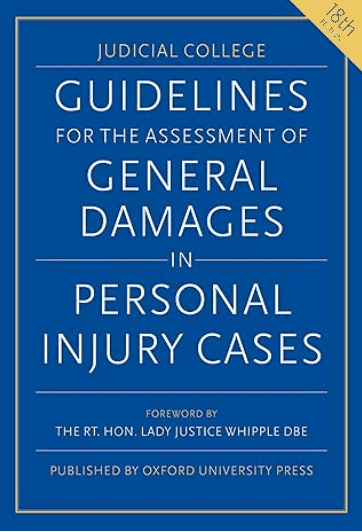
The Judicial College Guidelines (“JCG”) are an established and widely used tool in the valuation of personal injury claims. Although produced for England and Wales, they play a significant and practical role in Scottish litigation, particularly in the assessment of solatium.
Although the JCG relate to English general damages, they closely align with Scottish solatium, as both compensate pain, suffering and loss of amenity. While terminology and structure differ, the underlying valuation exercise is materially the same, allowing the Guidelines to serve as a useful cross-jurisdictional benchmark in Scottish practice, alongside domestic authority.
The publication of the 18th edition in April 2026 provides a timely opportunity to reflect on their purpose and continuing importance in practice.
What are the Judicial College Guidelines?
The JCG are published by the Judicial College and are designed to assist in the assessment of general damages for pain, suffering and loss of amenity. They draw together a large body of case law and present it in a structured format, with bracketed compensation ranges for different categories of injury.
In doing so, the Guidelines:
- Categorise injuries by type and severity;
- Provide indicative valuation ranges;
- Highlight factors which may influence where a case falls within a bracket.
For practitioners, they offer a clear and accessible framework for approaching valuation, helping to anchor discussions in a consistent and recognisable structure.
The Role of the Guidelines in Scotland
In Scottish practice, the JCG are a familiar and frequently used reference point when assessing solatium.
They are particularly valuable in:
- Providing a useful benchmark for valuing injuries;
- Assisting in the preparation and presentation of claims;
- Supporting negotiations by offering a commonly understood framework.
For pursuers, the Guidelines are especially helpful in ensuring that valuations properly reflect the full impact of an injury, particularly in cases where domestic authority may be limited or less recent. They also promote consistency across claims, which is advantageous when advancing well-supported valuations.
The 18th Edition: Overview
The 18th edition continues the established approach of the Guidelines, updating valuation brackets to reflect recent case law and current economic conditions.
While the overall structure remains familiar, the updated figures and targeted revisions ensure that the JCG remain aligned with modern awards and expectations.
Key Updates in the 18th Edition
Inflationary increase and use of RPI
A key feature of the 18th edition is the application of an uplift to reflect inflation. The updated brackets have been increased by approximately 8.2%, based on changes in the Retail Prices Index (RPI).
This continues the established approach of ensuring that awards maintain their real-terms value in light of economic conditions. The express use of RPI as the reference point also provides greater transparency in how these adjustments are calculated.
For pursuers, this uplift is significant. It supports valuations which properly reflect present-day conditions and helps ensure that compensation keeps pace with the rising cost of living.
Updated and additional injury categories
The 18th edition includes a number of refinements to specific injury categories.
These include:
- The introduction of a bracket addressing claims involving miscarriage;
- Revisions to epilepsy-related injuries;
- Updates to categories involving abuse claims.
These developments reflect the evolving nature of personal injury litigation and ensure that the Guidelines continue to capture a broad and realistic range of injuries and their effects.
Ongoing practical utility
The strength of the JCG lies in their usability. They remain a practical, working document that can be readily applied to the facts of individual cases.
By offering structured ranges rather than fixed figures, they allow practitioners to present valuations that are both flexible and well-supported, taking into account:
- The severity of the injury;
- The duration of symptoms;
- The impact on the pursuer’s day-to-day life.
Conclusion
The 18th edition of the Judicial College Guidelines represents a continuation of a well-established and highly practical resource for personal injury practitioners.
For those acting for Pursuers in Scotland, the Guidelines remain an important tool in advancing fair and realistic valuations of solatium. Their structured approach, combined with updated figures, provides a strong foundation for ensuring that compensation properly reflects the impact of injury in today’s context.
How Jackson Boyd Can Help
Our specialist personal injury lawyers represent clients across Scotland in road traffic accident, employer liability and public liability claims. Learn more about our Personal Injury Services.